
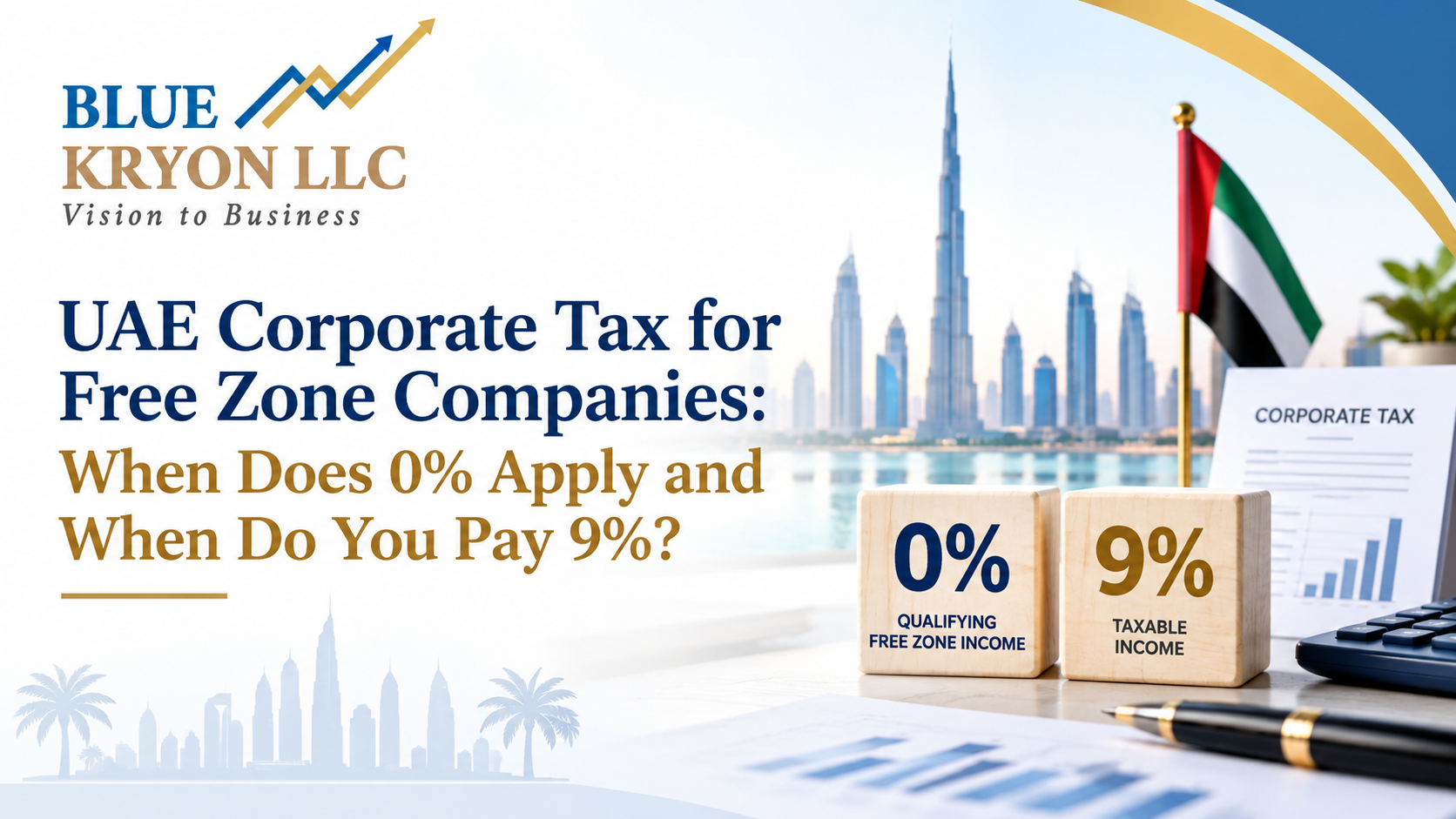
UAE Corporate Tax for Free Zone Companies: When Does 0% Apply and When Do You Pay 9%?
A UAE Free Zone licence does not automatically mean 0% Corporate Tax.
That is probably the most important thing every Free Zone business owner should understand in 2026.
A company can benefit from 0% UAE Corporate Tax on Qualifying Income when it meets the conditions to become a Qualifying Free Zone Person (QFZP). Income that does not qualify can instead be taxed at 9%.
So the real question isn’t:
“Is my company in a Free Zone?”
It is:
“Does my company qualify for the Free Zone Corporate Tax regime, and which of my income qualifies for 0%?”
Here is how it works.
UAE Corporate Tax for Free Zone Companies: 0% vs 9% at a Glance
| Situation | Corporate Tax Treatment |
| QFZP earning Qualifying Income | 0% |
| QFZP earning Taxable Income that is not Qualifying Income | 9% |
| Free Zone company that fails QFZP conditions | Standard UAE Corporate Tax rules apply |
| Ordinary taxable business under standard regime | 0% up to AED 375,000 taxable income; 9% above |
| QFZP non-qualifying taxable income | 9% without the AED 375,000 threshold |
The final point is often missed.
The FTA confirms that a Qualifying Free Zone Person cannot use the standard AED 375,000 0% threshold against its non-qualifying taxable income.
What Is a Qualifying Free Zone Person in the UAE?
A Qualifying Free Zone Person (QFZP) is a Free Zone entity that satisfies the conditions required under the UAE Corporate Tax Law to access the 0% Corporate Tax rate on Qualifying Income.
Simply holding an IFZA, DMCC, JAFZA, Meydan, RAKEZ, DAFZA, DIFC or another Free Zone licence does not itself guarantee 0%.
To maintain QFZP status, a company generally needs to:
- Maintain adequate substance in the UAE
- Generate Qualifying Income
- Stay within the permitted level of non-qualifying revenue
- Comply with the arm’s-length principle
- Meet applicable transfer pricing requirements
- Prepare and maintain audited financial statements
- Not elect to be taxed under the standard Corporate Tax regime
Ministerial Decision No. 84 of 2025 specifically requires all Qualifying Free Zone Persons to prepare and maintain audited financial statements, regardless of their revenue size.
When Does 0% Corporate Tax Apply to a UAE Free Zone Company?
The 0% Corporate Tax rate applies to the Qualifying Income of an eligible QFZP.
There are two important routes to Qualifying Income.
1. Income from Other Free Zone Persons
Income from transactions with another Free Zone Person can generally qualify where:
- The customer is a Free Zone Person
- That customer is the Beneficial Recipient of the goods or services
- The transaction does not arise from an Excluded Activity
- All other QFZP requirements are met
A customer cannot simply act as an intermediary while the real recipient sits elsewhere if you want to rely on this test.
2. Income from Qualifying Activities
A common misconception is that all income from Mainland UAE customers automatically attracts 9% Corporate Tax.
That is too simplistic.
A QFZP may still generate Qualifying Income from a Non-Free-Zone Person where the income arises from a recognised Qualifying Activity and is not an Excluded Activity.
Qualifying Activities under the current UAE Free Zone Corporate Tax rules include:
- Manufacturing of goods or materials
- Processing of goods or materials
- Trading of Qualifying Commodities
- Holding shares and other securities for investment
- Ownership, management and operation of qualifying ships
- Reinsurance services
- Fund management services
- Wealth and investment management services
- Headquarter services to Related Parties
- Treasury and financing services to Related Parties or for the company’s own account
- Financing and leasing of aircraft
- Distribution of goods or materials in or from a Designated Zone
- Logistics services
- Activities ancillary to the above qualifying activities
These activities are set out under Ministerial Decision No. 229 of 2025, which replaced the previous 2023 decision.
What Income Does Not Qualify for the 0% Free Zone Corporate Tax Rate?
Some activities are specifically treated as Excluded Activities.
Common Excluded Activities include:
- Certain transactions with natural persons
- Banking activities
- Certain insurance activities
- Certain finance and leasing activities
- Ownership or exploitation of immovable property, subject to limited exceptions
- Activities ancillary to an Excluded Activity
For example, property income is not automatically eligible for 0% simply because the property-owning company is registered in a Free Zone.
The current rules provide a limited exception for certain transactions involving commercial property located in a Free Zone and transacted with another Free Zone Person.
What Is the De Minimis Rule for UAE Free Zone Corporate Tax?
A QFZP is allowed to earn a limited amount of non-qualifying revenue without immediately losing its status.
This is known as the de minimis requirement.
Non-qualifying revenue must not exceed the lower of:
5% of total revenue
OR
AED 5 million
whichever is lower.
Example
Suppose a Free Zone company has:
- Total revenue: AED 4,000,000
- Non-qualifying revenue: AED 150,000
5% of AED 4 million = AED 200,000
Since AED 150,000 is below AED 200,000, the company remains within the de minimis limit, assuming all other QFZP conditions are satisfied.
Now suppose non-qualifying revenue becomes AED 250,000.
The company has crossed the 5% limit and could lose its QFZP status.
That is why companies should monitor qualifying and non-qualifying revenue throughout the year, not wait until Corporate Tax filing time.
What Happens If You Lose Qualifying Free Zone Person Status?
This is where the risk becomes serious.
If a Free Zone Person fails the QFZP conditions—including the de minimis requirement—it can lose its Qualifying Free Zone Person status for:
The current Tax Period + the following four Tax Periods.
In other words, a compliance mistake can affect five Tax Periods.
During the disqualification period, the company is treated under the normal Corporate Tax regime rather than continuing to benefit from the special QFZP treatment.
So protecting 0% is not merely about how you invoice.
It also depends on:
- Proper activity classification
- Customer classification
- Revenue segregation
- Substance
- Transfer pricing
- Audited accounts
- Reliable bookkeeping
When Does a Free Zone Company Pay 9% Corporate Tax in UAE?
There are several situations where the 9% UAE Corporate Tax rate becomes relevant.
A Free Zone company may pay 9% when:
1. A QFZP earns non-qualifying taxable income
The non-qualifying taxable income is subject to 9% Corporate Tax.
Importantly, the AED 375,000 normal 0% threshold does not apply to this QFZP income.
2. The company fails QFZP conditions
If the company loses its QFZP status, it enters the standard Corporate Tax regime for the applicable disqualification period.
3. The company elects to use the standard Corporate Tax regime
A Free Zone Person can elect to be subject to normal Corporate Tax rules instead of applying the QFZP regime.
This can sometimes make sense when a company’s business model produces significant amounts of non-qualifying income.
Does Every Free Zone Company Need Corporate Tax Registration?
Yes, being eligible for a 0% rate does not mean you can ignore Corporate Tax compliance.
Free Zone Persons remain within the UAE Corporate Tax system and must meet applicable registration and filing obligations.
A company paying 0% may still need to:
- Register for Corporate Tax
- Obtain a Corporate Tax Registration Number
- Maintain accounting records
- Prepare financial statements
- Maintain supporting documentation
- File its Corporate Tax return
- Keep transfer pricing documentation where required
- Maintain audited financial statements if it is a QFZP
0% tax does not mean 0 compliance.
UAE Corporate Tax Filing Deadline for Free Zone Companies
Corporate Tax returns and any Corporate Tax payable are generally due within nine months from the end of the Tax Period.
For example:
If your financial year ends on 31 December 2026, your normal filing and payment deadline would generally fall at the end of September 2027, subject to applicable FTA rules or any specific extensions.
The FTA also requires relevant records to generally be retained for at least seven years after the end of the Tax Period.
Can a Small Free Zone Company Use Small Business Relief?
There is an important distinction here.
The UAE has extended Small Business Relief for eligible businesses with revenue not exceeding AED 3 million through Tax Periods ending on or before 31 December 2029.
However:
A Qualifying Free Zone Person cannot claim Small Business Relief.
A Free Zone Person that is not a QFZP may potentially elect for Small Business Relief if it satisfies all applicable eligibility conditions.
This is another reason why the “0% or 9%?” decision needs to be reviewed based on your company’s actual circumstances rather than the name of your Free Zone.
2026 UAE Free Zone Corporate Tax Checklist
Before filing your return, ask these questions:
- Is my business genuinely a Qualifying Free Zone Person?
- Which revenue streams are Qualifying Income?
- Do I earn income from Excluded Activities?
- Are transactions with customers correctly classified?
- Is non-qualifying revenue below the 5% / AED 5 million de minimis limit?
- Do I maintain adequate substance in the UAE?
- Are related-party transactions priced at arm’s length?
- Are my books and supporting documents complete?
- Have audited financial statements been prepared?
- Is my Corporate Tax return due soon?
If you cannot confidently answer these questions, review the tax position before filing.
Common Free Zone Corporate Tax Mistakes to Avoid
Assuming the Free Zone licence guarantees 0%
It doesn’t. The tax benefit depends on QFZP status and Qualifying Income.
Treating every Mainland customer as automatically taxable at 9%
Some transactions with Non-Free-Zone Persons can still generate Qualifying Income where they relate to specified Qualifying Activities.
Ignoring the de minimis limit
Crossing the threshold can jeopardise QFZP status.
Applying the AED 375,000 threshold to QFZP non-qualifying income
The FTA states that this standard threshold is not available against the non-qualifying taxable income of a QFZP.
Waiting until year-end to classify income
Qualifying and non-qualifying transactions should ideally be tracked throughout the year.
Skipping the audit because revenue is low
QFZPs are required to prepare and maintain audited financial statements irrespective of their size.
Not Sure Whether Your Free Zone Company Qualifies for 0%?
Do not wait until the Corporate Tax return is due to discover that part of your income does not qualify.
Get your Free Zone Corporate Tax position reviewed by Blue Kryon LLC and understand whether your business qualifies for 0%, where 9% may apply and what needs to be corrected before filing.
CTA: Book a Free Corporate Tax Consultation
FAQs About UAE Corporate Tax for Free Zone Companies
1. Do Free Zone companies pay Corporate Tax in the UAE?
Yes. Free Zone companies fall within the UAE Corporate Tax system. A Qualifying Free Zone Person may receive a 0% Corporate Tax rate on Qualifying Income, while non-qualifying taxable income can be subject to 9%.
2. Is Corporate Tax automatically 0% for Free Zone companies?
No. A Free Zone licence alone does not guarantee 0%. The business must meet the conditions to be a Qualifying Free Zone Person and the relevant income must meet the Qualifying Income rules.
3. What is a Qualifying Free Zone Person?
A Qualifying Free Zone Person is a Free Zone entity that meets the UAE Corporate Tax conditions relating to Qualifying Income, adequate substance, transfer pricing, audited financial statements and other requirements.
4. What is the de minimis rule for UAE Free Zone companies?
Non-qualifying revenue must not exceed the lower of 5% of total revenue or AED 5 million during the relevant Tax Period if the company wants to satisfy the de minimis requirement.
5. Does the AED 375,000 0% threshold apply to a QFZP’s non-qualifying income?
No. The FTA states that a QFZP is not entitled to use the normal 0% threshold of AED 375,000 against its taxable income that is not Qualifying Income. That income is subject to 9%.
6. Can income from Mainland customers qualify for 0% Corporate Tax?
Potentially, yes. Income from a Non-Free-Zone Person can qualify where it arises from specified Qualifying Activities, is not an Excluded Activity and all other QFZP conditions are satisfied.
7. Does a QFZP need audited financial statements?
Yes. Under Ministerial Decision No. 84 of 2025, every Qualifying Free Zone Person must prepare and maintain audited financial statements.
8. What happens if a Free Zone company loses QFZP status?
The company can cease to qualify for the special Free Zone Corporate Tax regime for the Tax Period in which the conditions fail and the following four Tax Periods, making the consequence potentially a five-period issue.